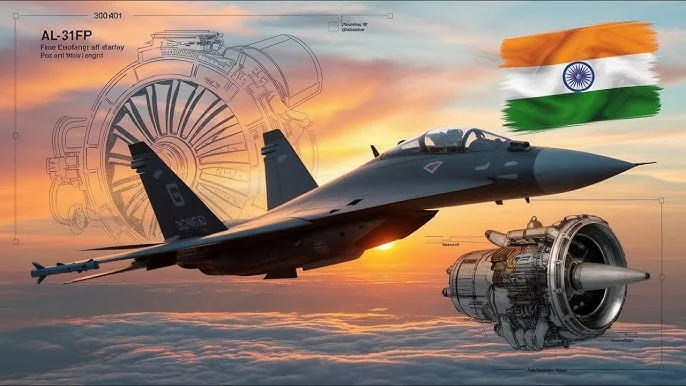
New Delhi: Hindustan Aeronautics Limited (HAL) has successfully extended the Total Technical Life (TTL) of the AL-31FP turbofan engine to 2,500 flying hours — a significant development for the Indian Air Force.
The first engine to be overhauled under this life-extension programme was handed over to the IAF on January 8, 2026, marking an important step toward improving the long-term operational readiness of the Su-30MKI, India’s primary air superiority fighter.

Manufactured at HAL’s Koraput facility in Odisha under a deep technology-transfer arrangement, the AL-31FP powers the Su-30MKI, the twin-engine fighter that forms the backbone of India’s combat air power, with around 260 jets currently in service.
The base version of the AL-31FP had a certified service life of 2,000 hours. Raising that ceiling — and reducing how often engines need to go through full overhauls — is key to keeping more aircraft mission-ready at any given time while bringing down overall maintenance costs.
The significance of this indigenous production line was underlined in September 2024, when the Ministry of Defence placed a ₹26,000 crore order with HAL for 240 new AL-31FP engines.
With the extended TTL, each engine can now safely log up to 2,500 flying hours before retirement, cutting down substantially on the frequency of engine changes and depot-level repairs. In practical terms, this should translate into higher sortie generation rates and smoother logistics at airbases.

Given that the AL-31FP features thrust-vectoring control for high manoeuvrability and produces roughly 12.5 tonnes of thrust with afterburner, keeping these engines flying longer between overhauls is a meaningful operational gain for the Air Force.
This wasn’t a quick fix — it’s the result of extensive engineering evaluation, ground testing, and strict validation carried out through the overhaul process. By certifying the extended life on its own, HAL has demonstrated growing in-house expertise in sustaining advanced military jet engines, marking a further step away from dependence on Russian OEMs for critical engine support.
The delivery of the first overhauled engine on January 8 sets the baseline for all future AL-31FP overhauls, which will now follow this enhanced maintenance framework.
The timing matters strategically. The Su-30MKI fleet is expected to remain India’s frontline fighter well into the 2030s and is currently undergoing the “Super Sukhoi” upgrade, which includes indigenous avionics, modern electronic warfare systems, and India-made weaponry. Extending engine life fits neatly alongside these upgrades, helping ensure aircraft aren’t grounded by premature engine wear even as their roles expand.
The development also feeds into the broader Aatmanirbhar Bharat push by strengthening India’s domestic Maintenance, Repair and Overhaul (MRO) capability. HAL has steadily raised indigenous content in the AL-31FP over the years — reportedly over 54% on average in recent batches — while building up expertise in complex manufacturing and repair processes. The extended engine life means a larger share of the Su-30MKI’s lifecycle support will now stay firmly within India.